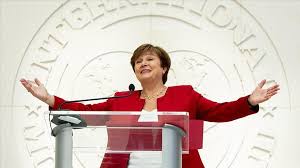
Ahead of the IMF–World Bank Annual Meetings (October 13–18), IMF Managing Director Kristalina Georgieva delivered a speech titled “Opportunities in a Time of Change,” addressing the global economic outlook and key policy priorities.
Georgieva noted that global uncertainty is rising — and will remain elevated:
“Be prepared — uncertainty is the new normal, and it is here to stay.”
“The World Economy Is Coping Better Than Feared”
She explained that next week’s meetings will bring together finance ministers and central bank governors to discuss the global impact of economic transformation and ongoing policy turbulence.
Georgieva said the world economy is performing better than feared but worse than needed. She recalled that when the IMF met in April, many experts predicted a U.S. recession that would negatively affect the rest of the world. Instead, both the U.S. and many advanced and emerging economies have remained resilient.
The upcoming World Economic Outlook report, to be released next week, forecasts that global growth will slow only slightly this year and next. Georgieva stated:
“All indicators point to a world economy that has generally withstood the severe pressures from multiple shocks.”
She attributed this resilience to sounder policy foundations, the private sector’s adaptability, tariffs proving less damaging than feared, and supportive financial conditions.
Call to Protect Trade as an “Engine of Growth”
Georgieva cautioned that the global economy’s resilience has not been fully tested, and warning signs suggest a tougher test may lie ahead.
She pointed to the surging global demand for gold, noting that monetary gold holdings — boosted by valuation effects and geopolitical factors — now exceed one-fifth of total official reserves.
On trade tensions, she said the full impact of tariffs has yet to materialize:
“In the United States, margin compression could lead to more price pass-through, potentially fueling inflation and affecting monetary policy and growth. Elsewhere, goods previously destined for the U.S. market may be redirected, triggering a second round of tariff hikes.”
Georgieva urged policymakers to preserve trade as a driver of growth, emphasizing that most global trade still operates under established rules.
Global Growth Expected to Average Around 3%
Medium-term global growth is projected at around 3%, below the pre-pandemic average of 3.7%.
Georgieva noted shifting growth dynamics: China’s momentum is slowing, while India is emerging as a key engine of growth. She called on Asian economies to deepen regional trade, expand into final goods and services, and accelerate reforms to strengthen the service sector and access to finance.
For Sub-Saharan Africa, she said reforms could deliver “tremendous returns,” given the region’s young and growing workforce.
In Europe, she urged policymakers to remove cross-border barriers in labor markets, trade, energy, and finance — and to build a unified European financial and energy system. Georgieva emphasized that Europe must match the U.S. in private sector dynamism.
Global Public Debt to Exceed 100% of GDP by 2029
Georgieva warned that global public debt is projected to surpass 100% of GDP by 2029, driven by both advanced and emerging economies. Rising debt, she said, is inflating interest payments, raising borrowing costs, constraining fiscal space, and reducing governments’ ability to absorb shocks.
She expressed concern that development aid from advanced economies to the world’s poorest nations continues to decline and called for fiscal consolidation in both rich and poor countries.
Country-Specific Recommendations: U.S. and China
For the United States, where private consumption and fiscal deficits are high and the current account deficit has reached levels unseen since the early 2000s, Georgieva urged comprehensive action — including steps to reduce the federal deficit and encourage household savings.
For China, where private savings are chronically high and domestic demand is weak due to prolonged property adjustments and deflationary pressures, she recommended temporary fiscal expansion coupled with lasting fiscal restructuring.
She said China needs a fiscal-structural package to boost private consumption, shift to a new growth model, and revitalize the economy — which would also help offset the recent depreciation of the real exchange rate.
Georgieva concluded by reaffirming that adaptability and international cooperation will be key to navigating a world where uncertainty has become the rule, not the exception.